The first time you hear someone say, “Wrap your car key in aluminum foil,” it sounds like a bad joke or the start of a conspiracy thread. You picture a crumpled ball of kitchen foil sitting by the front door and you can almost hear your partner asking, half-laughing, half-concerned: “Are we really doing this now?”
But it’s usually not a joke that starts it. It’s a neighbour whose car vanished in the night. A viral video showing thieves casually “ghost unlocking” a vehicle without touching the keys. A police warning dropped into your social feed right between a lasagna recipe and a cat video.
That’s when this strange little ritual suddenly feels less crazy and more like a quiet, desperate kind of common sense.
There’s a reason people are wrapping their keys.
Relay attacks: when your car key betrays you from the kitchen table
Most of us treat our key fobs like any other object we throw on the sideboard the moment we walk through the door. Keys, wallet, phone, done. The car is outside, locked, silent, “far away”.
Except for one detail: your modern key fob never really sleeps. It constantly whispers a low-power radio signal, just waiting for your car to reply. It feels like magic when you touch the handle and it unlocks. That same magic is exactly what thieves have learned to abuse.
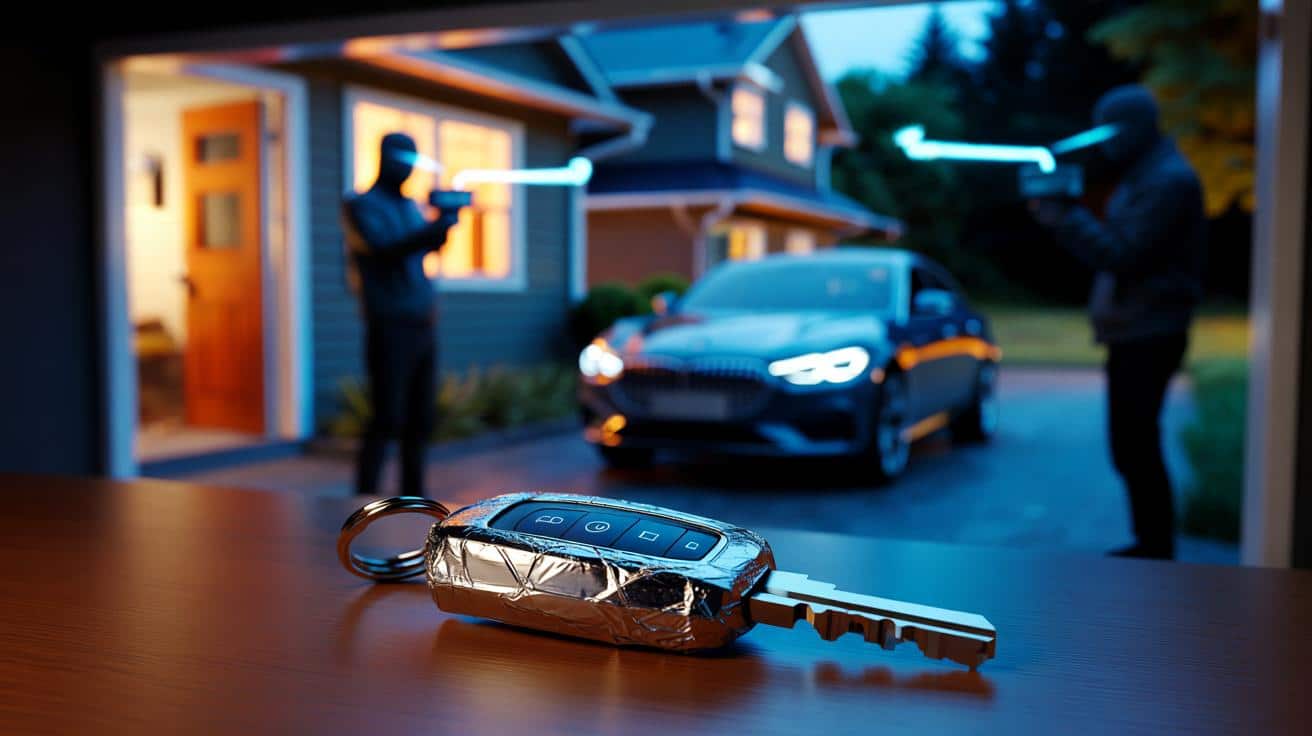
Picture this scene from a suburban street in Birmingham, Lyon, Toronto, wherever you live. It’s 2:30 a.m. Two people move quietly along the pavement. One stands close to your front wall, holding a flat black device that looks like an oversized smartphone. The other stands by your car with a similar box.
The first device “catches” the weak signal from your key fob sitting on the hallway table. The second device “repeats” that signal to your car, as if your key were right next to it. The car happily unlocks and starts. No smashed windows. No forced locks. Just a smooth, almost polite theft.
This is called a relay attack, and police forces across Europe and North America have been warning about it for several years. Many car thefts now happen without any physical break-in at all, and CCTV footage often shows thieves doing their work in under a minute.
The logic is cruelly simple: if the car believes your key is nearby, it cooperates. If thieves can “extend” your key’s signal from inside your house to your driveway, they don’t need your actual key. So the real vulnerability isn’t always the car. It’s that unassuming little fob lying next to your front door, broadcasting loyalty to the wrong ears.
➡️ Forget baking soda: this housekeeper’s trick makes bad odors disappear for good
➡️ One spoon is enough : Why more people are putting coffee grounds in the toilet
➡️ We Asked 5 Chefs How to Make Perfect Scrambled Eggs – They All Gave the Same Answer
➡️ Better than a store-bought mask: the recipe estheticians use to hydrate the face
Why a piece of aluminum foil suddenly matters
Here’s where the kitchen drawer becomes your first line of defence. Aluminum foil acts like a basic Faraday cage: a kind of electromagnetic shield. When you wrap your key fob tightly in foil, you’re creating a small barrier that absorbs or reflects the radio waves your key uses to talk to your car.
Done properly, the signal is weakened so much that those relay boxes outside can’t amplify anything useful. Your key is still “talking”, but it’s doing it from behind a thick, muffled wall. The thieves’ devices are left listening to static.
If that sounds a bit sci‑fi, think of a simple test some security experts use. They walk up to the car with the wrapped key and try to open the door. If the foil is doing its job, the car won’t unlock, even though the key is technically within range. Remove the foil and suddenly the door opens with that soft, familiar click.
Real-world police and insurance data back this up: cars with keys stored in signal-blocking pouches, boxes, or even DIY foil wraps are statistically less attractive to relay thieves, who prefer quick wins and low resistance. They walk down streets “fishing” for signals. If yours is quiet, they move on to the next house.
Under the hood, your key fob uses radio frequencies, usually around 315 MHz or 433 MHz, sometimes higher for true keyless entry. Aluminum is conductive, so a snug layer around the key disrupts the electromagnetic field created by those frequencies. The signal bounces, cancels out, or gets trapped inside that little metal cocoon.
It’s not perfect tech. A loose, half-hearted wrap won’t block as much. Some high-end relay tools are getting stronger each year. But the core idea stays the same: block or dampen the signal, and you cut the “extender” thieves out of the conversation. *For a few cents of foil, you make their expensive gadget almost useless.*
How to wrap your key fob so it actually works
If you’re going to do the aluminum trick, do it like you mean it. Tear off a rectangle of foil big enough to wrap your key at least twice, with overlap on every side. Place the key in the centre, fold the foil over it, then gently press around the edges to seal any gaps. You want a tight little parcel, not a loose silver nest.
Then test it. Walk to your car with the foil-wrapped key in your hand or pocket. Try to unlock the door using the handle or the button on the fob. If the car stays stubbornly shut, your mini Faraday cocoon is doing its job.
A lot of people do this once, feel silly, and then just go back to leaving the keys on the sideboard. Let’s be honest: nobody really does this every single day unless they’ve had a scare.
That’s why many security-conscious drivers combine habits. Some keep a dedicated foil-lined tin or old biscuit box by the door, lined with aluminum inside. Drop the key in, close the lid, done. Others buy purpose-made signal-blocking pouches, then line them with an extra layer of foil when the fabric starts to wear. The goal isn’t a perfect lab-grade shield. It’s a consistent barrier that turns your hallway into a dead zone for key fob signals.
Security consultant Mark H., who works with insurers on vehicle theft claims, sums it up this way: “You don’t need military-level tech. You just need to be a harder target than the car parked three doors down. Thieves are lazy in a very professional way.”
Alongside foil, a few other habits can quietly stack the odds in your favour:
- Store keys as far from doors and windows as possible, not on that tempting hook by the front door.
- Use a metal tin, signal-blocking pouch, or **foil-lined box** for both main keys and spares.
- Turn off passive keyless entry in your car settings if your model allows it.
- Consider an old-school steering wheel lock as a visible **second barrier**.
- Ask your dealer about **software updates** or upgraded keys with motion sensors that sleep when not moved.
Even if you only pick two or three of these, you’re already ahead of most people on your street.
Living with smart cars in a low-tech, slightly paranoid way
The whole story of keyless car theft is a bit of a metaphor for the way we live now. We love frictionless tech: doors that open on touch, engines that start with a button, apps that remember everything so we don’t have to. Then, slowly, we discover the flip side: the easier it is for us, the easier it often becomes for someone else.
We’ve all been there, that moment when you read about a new scam or hack and suddenly look at a totally normal object in your home with fresh suspicion. Once you’ve seen the footage of a car disappearing silently thanks to a signal bouncing through your living room wall, it’s hard to unsee.
The foil trick sits in that awkward space between clever and ridiculous. You can laugh at it and still do it. You can use it while you wait for car manufacturers to roll out smarter keys that sleep when motionless, tighter authentication, better software.
Until that tech becomes standard for everyone, a crumpled square of kitchen foil is a strangely honest symbol of where we are: high-tech vehicles, low-tech defences, and ordinary people trying to keep up. Sometimes the best you can do is slow the bad guys down, talk about it with your neighbours, and wrap that little piece of plastic and circuit board before you go to bed.
| Key point | Detail | Value for the reader |
|---|---|---|
| How relay theft works | Thieves use devices to extend your key fob’s signal from inside your home to your car | Helps you understand why your car can be stolen without the key being touched |
| Why aluminum foil helps | Foil creates a basic Faraday cage that blocks or weakens radio signals from the fob | Gives you a cheap, instant way to cut off the signal thieves rely on |
| Daily protective habits | Storing keys away from doors, using tins or pouches, disabling passive entry when possible | Provides a realistic routine that fits into everyday life and reduces theft risk |
FAQ:
- Does wrapping my key in foil damage it?Under normal use, no. Aluminum foil doesn’t harm the electronics; just avoid crushing buttons or bending the key excessively when wrapping.
- Is foil as good as a dedicated Faraday pouch?Good-quality pouches are more convenient and durable. Foil can block the signal very effectively if wrapped tightly, but it tears and wears faster.
- How can I test if my key is really blocked?Wrap the key, stand next to your car, and try to unlock or start it. If nothing happens, the signal is blocked enough for everyday protection.
- Should I wrap my spare keys too?Yes. Thieves don’t care which key they’re relaying. A spare left in a drawer near the front of the house can be just as vulnerable as the main one.
- Is this still necessary if I live in a “quiet” area?Relay theft often targets quiet, residential streets because they’re low-risk for thieves. The calm of the neighbourhood doesn’t mean your car isn’t on a list.