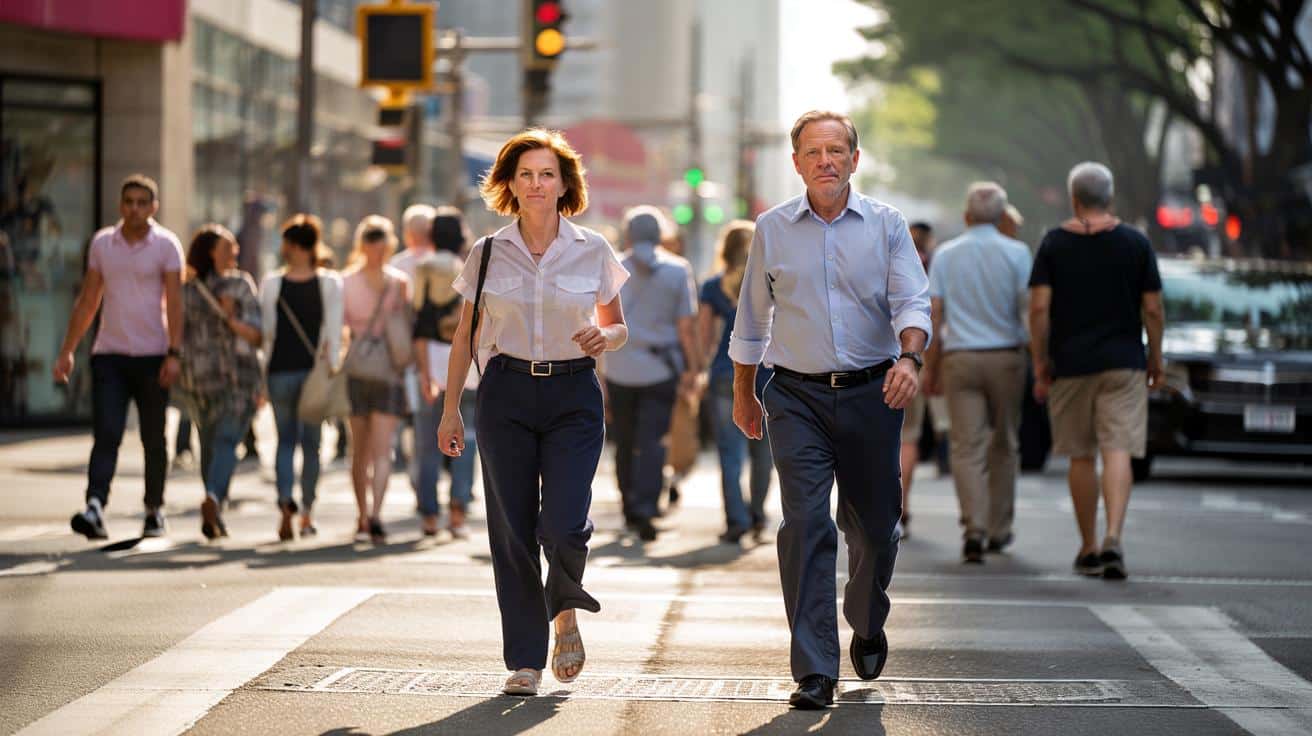
The woman in the grey coat doesn’t look at her phone.
She just walks — head up, arms swinging, weaving through the crowd like she knows exactly where her life is going. Two steps behind, a man of the same age shuffles along, shoulders rounded, dragging one foot slightly as the traffic light blinks red again.
On a busy city sidewalk, you barely notice these details. You’re late, you’re thinking about your day, you’re speed-walking or strolling without asking why. Yet researchers are doing exactly that: watching how fast people walk, timing their steps with quiet obsession.
Because your walking speed isn’t just a random habit. It acts like a silent health report your body gives off every single day. And the numbers are surprising.
What your pace really says about your future health
Stand on any street corner long enough and you start seeing patterns. The brisk walkers tend to look alert, eyes scanning ahead, bodies slightly leaning forward as if life is pulling them on a string. The slow walkers often seem like they’re carrying an invisible backpack — of fatigue, of pain, of worries they don’t fully name.
Doctors have a clinical name for this everyday detail: “gait speed.” It sounds technical, but it’s just how long it takes you to walk a short distance at your usual pace. The wild part? This simple measure has been linked to how long you’re likely to live, how your brain ages, and how your heart holds up over time.
In one large study, adults who walked faster at their “usual pace” tended to live longer than those who moved slowly. We’re not talking athletes sprinting marathons, just regular people on a normal day. Their walking speed predicted survival almost as well as age or blood pressure. That’s why some geriatric clinics quietly time how long it takes older adults to walk a few meters. No fancy machines, just a stopwatch and a hallway.
There’s a logic behind this that feels almost obvious once you hear it. Walking is a full-body negotiation: your heart has to pump efficiently, your lungs have to deliver oxygen, your muscles have to coordinate, your nerves and brain have to stay in sync. If any of those systems are struggling, your pace usually drops long before something “serious” shows up on a scan.
Think about it as an integration test. One step is your cardiovascular system, your balance, your joints, your mood, your sleep, your nutrition — all reporting in, at the same time. *If your walking speed has quietly slowed over the past few years, it might be your body’s way of whispering that something underneath needs attention.*
Researchers also find that people with slower walking speeds, especially in midlife, may be at higher risk for cognitive decline later on. Not because walking speed magically controls your brain, but because both are reflections of the same long-term wear and tear. Your pace becomes a proxy for how well your body and mind are aging together.
How to “train” your walking speed without turning into a gym person
You don’t need a smartwatch or a lab to start using walking speed as a quiet compass. One simple method used in studies is the 4-meter walk test. Pick a flat stretch at home or in a hallway, measure 4 meters (about 13 feet), and walk it at your normal pace while someone times you. Divide distance by time, and you have your speed in meters per second.
➡️ One spoon is enough : Why more people are putting coffee grounds in the toilet
➡️ We Asked 5 Chefs How to Make Perfect Scrambled Eggs – They All Gave the Same Answer
➡️ Neither in the box nor in the fridge door: how to store eggs to protect your health
➡️ The hidden link between dehydration and sudden headaches
If that feels too technical, there’s a more everyday trick: the “conversation pace” test. Walk at your normal speed and see if you can comfortably speak in full sentences without gasping. If you can chat but feel slightly energized, you’re probably in a healthy zone. If normal walking leaves you breathless, that’s worth noticing, not ignoring.
Once you have a rough sense of your pace, you can start playing with it. One or two times a week, on a route you know well, walk a little faster than usual for 30–60 seconds, then slow back down. Think of it as turning the volume up just a notch, not going all-out. Over weeks, those tiny pushes can gently raise your natural cruising speed without making you feel like you just signed up for a boot camp you’ll quit by Thursday.
Most people don’t slow down overnight. It happens by millimeters, over years. A little more sitting here, a few skipped walks there, that nagging knee you “protect” by moving less. On a rainy Tuesday, it doesn’t feel like a big deal. Over a decade, it quietly rewrites how you move through the world.
There’s also the emotional side. When you’re stressed, depressed, or burnt out, your body often reflects it. Your shoulders curl in, your steps get shorter, your pace drags. That doesn’t mean you’re doing something wrong — it means the line between mental health and physical movement is thinner than we pretend. Some people notice that on days when they feel more hopeful, their feet naturally pick up speed.
Soyons honnêtes : personne ne fait vraiment ça tous les jours. Few of us are timing our hallway walks or tracking exact speeds. What does help is paying gentle attention to trends. Are you more out of breath on the same hill you used to climb easily? Do you find yourself avoiding longer walks that once felt normal? Those are the quiet red flags that often show up long before dramatic diagnoses.
“Your walking speed is like your body’s credit score,” says one sports physician. “You can ignore it for a while, but eventually it tells the truth about how things are going under the surface.”
If that sentence stings a bit, it might be useful. The goal isn’t to obsess over every second, but to treat your daily steps as information you can act on. Some small, practical ideas to support a healthier pace:
- Pick one daily route — to work, to the bus, around the block — and make it your “benchmark walk”.
- Walk with someone slightly faster than you once a week to gently nudge your pace.
- Strengthen your legs twice a week (squats to a chair, calf raises at the sink).
- Protect your sleep; tired bodies walk slower and recover worse.
- If pain is making you slow down, talk to a professional instead of quietly shrinking your world.
Those aren’t life overhauls, just small levers. They can improve your walking speed, but also how confident you feel when you step out the door.
Rethinking your daily walk as a long-term investment
On some level, this is about dignity as much as data. Many older adults say the moment they notice they “can’t keep up” with family or friends on a simple walk is the moment they start feeling old. Not in years, but in possibility. The gap between how you want to move and how you actually move can hurt more than any lab result.
Your future self — ten, twenty, thirty years from now — won’t remember your number on the scale this week. They will remember whether you can walk to the bakery, climb the stairs to a friend’s apartment, cross the street before the light changes. A slightly faster, more confident walking speed today is like putting money into that future account.
On a more personal level, walking can become a quiet ritual. A daily check-in where you notice your breath, your pace, your mood. No performance, no app screaming goals at you. Just the honest question: how does my body move through the world right now?
Next time you’re out, watch people for a minute. The teenager sprinting across the road before the red light. The parent pushing a stroller at a determined clip. The older man pausing before each curb, calculating. Our walking speeds tell stories we rarely say out loud.
Maybe your story, for now, is “tired but trying”. Maybe it’s “stronger than last year”. Maybe it’s “starting again after injury”. All of those are valid. What your walking speed offers is a gentle, ongoing signal — a chance to notice, to adjust, to protect the years you haven’t lived yet.
And the next time you catch yourself hurrying for a train or strolling home at sunset, you might feel that tiny click of awareness: this pace isn’t random. It’s your past choices, your current health, and your future possibilities, all wrapped into the rhythm of your steps.
| Point clé | Détail | Intérêt pour le lecteur |
|---|---|---|
| Walking speed predicts longevity | Faster usual pace is linked to lower risk of early death and better overall health | Gives a simple, everyday indicator to watch without medical equipment |
| Slower pace can flag hidden issues | Changes in speed may reflect heart, lung, muscle, or brain problems before other signs | Encourages earlier checks and lifestyle changes, instead of waiting for a crisis |
| You can train your gait speed | Short, regular brisk intervals and leg strength work can improve natural walking pace | Offers concrete ways to “invest” in long-term independence and daily energy |
FAQ :
- How fast should I walk for good health?There’s no perfect number for everyone, but research often uses around 1.0–1.2 meters per second as a healthy usual pace for adults. Focus less on the exact speed and more on gradually being able to walk slightly faster and farther without feeling wiped out.
- Does a slow walking speed mean I’m unhealthy?Not automatically. Some people walk slowly by choice, personality, or culture. What matters more is if your natural pace has noticeably dropped, or if you struggle with short walks that used to feel easy.
- Can I improve my walking speed at any age?Yes. Studies show that even in your 70s or 80s, strength training and regular walking can make your gait faster and more stable. You won’t move like a teenager, but small gains can make daily life much easier.
- Is running better than walking for long-term health?Running can bring extra benefits for some people, yet brisk walking already covers a huge part of the health gains you’d expect from exercise. If walking is what you can and will do consistently, it’s more valuable than a running plan you abandon.
- When should I talk to a doctor about my walking speed?It’s worth a conversation if you suddenly slow down, feel unsteady, get chest pain or unusual breathlessness while walking, or start avoiding walks you once enjoyed. Bring specific examples — like “I used to climb these stairs easily, now I need two pauses.”