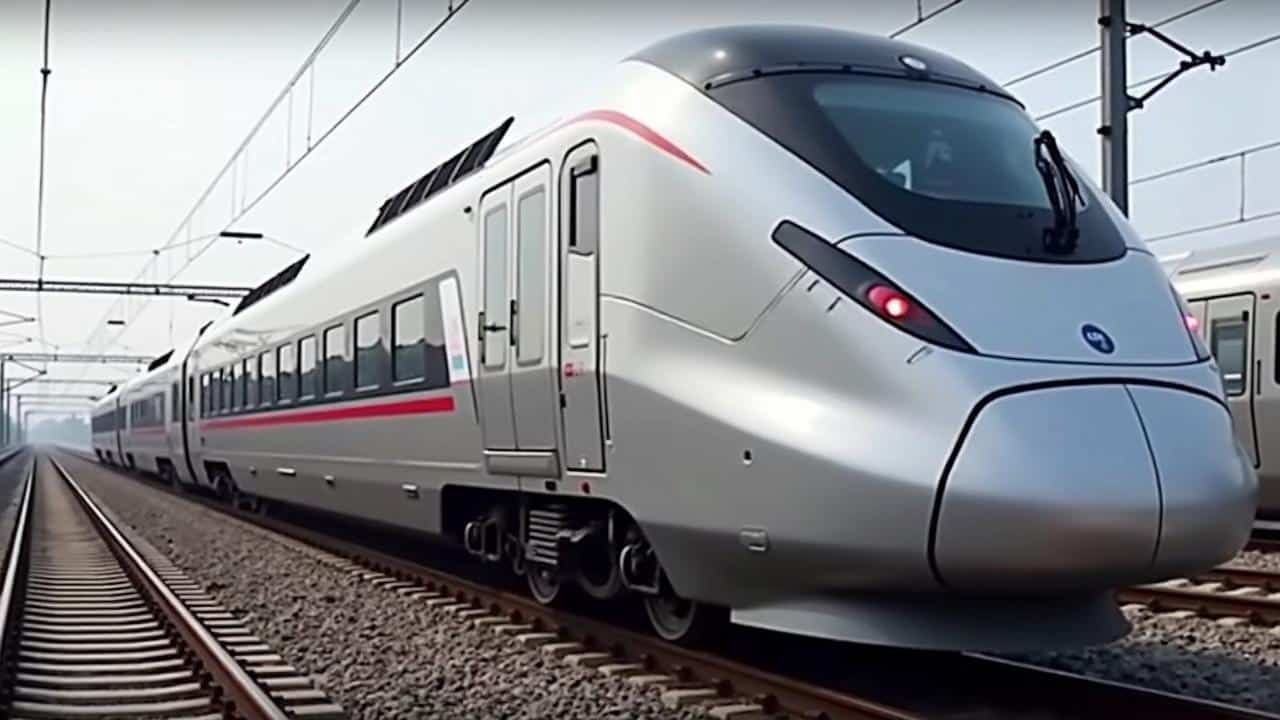
A long white nose, windows tinted like a pair of sunglasses, pantograph humming faintly in the cold morning air. People take pictures instead of boarding, half commuters, half trainspotters, everyone silently aware they’re about to test the edge of what steel wheels can do.
The doors slide shut with almost no sound. No rattling, no metallic echo. Just a low electric growl and that strange feeling when your body senses speed before your eyes do.
Somewhere between the rice fields and the towers, the screen flips: 430 km/h. A murmur runs through the carriage, phones raised, mouths half open. The French TGV once symbolised this feeling for Europe. Now, in the heart of China, another train is quietly stealing the spotlight.
From French pride to Chinese supertrain
For decades, the TGV was the poster child of high-speed rail. Orange nose, record-breaking runs, the promise that long distances could feel short and almost glamorous. It changed how Europeans thought about crossing a country, shrinking Paris–Lyon into something like a long coffee break.
Now the CR450 is edging into that same emotional territory for China. It is not just a faster train. It’s a statement on steel rails, meant to say: we can match the best, or *almost* beat it, on our own sprawling home turf.
The first time you sit inside, what strikes you is not just speed, but calm. No dramatic shaking, no roaring engine, just a fat, almost unreal number climbing on a small LED display. On long stretches, the CR450 feels less like travel and more like bending geography.
To understand why this matters, you have to go back to the bragging rights of the early 2000s. France still proudly holds the world speed record for conventional rail with a modified TGV reaching **574.8 km/h** in 2007. That record is legendary in rail circles, a marker in history like a lunar landing for trains.
China saw that, learned from it, then went in a different direction. Rather than chasing a single showy peak, the CR450 aims for brutal consistency: commercial speeds around 400–450 km/h, running daily, on huge distances, with real passengers and real timetables. Less fireworks, more repetition.
On test runs, the CR450 flirted with the 453 km/h mark, not quite touching the French record, yet changing the game in another way. It’s like comparing a sprinter to a marathon runner holding a near-sprint the whole race.
There’s also the raw scale. The TGV network is dense and mature, but China’s high-speed grid is continental in size, linking coastal megacities to inland provinces that used to be days away by slow trains. The CR450 is designed to live in that oversized playground.
➡️ Better than a store-bought mask: the recipe estheticians use to hydrate the face
➡️ A mother sets off to find her son missing for five years and what she discovers tears families apart
➡️ This supermarket butter under €4 is the healthiest choice, according to 60 Millions de consommateurs
That means not just raw speed, but fast acceleration, fast deceleration, and control systems tuned for constant, reliable high performance. It’s an athlete built not for one golden medal day, but for a punishing schedule of daily races.
How China quietly rewrote the rules of high-speed rail
If you look under the romantic shell of the CR450, what you find is meticulous engineering and a lot of learning by trial and error. The “450” in the name isn’t marketing fluff. It’s the design ceiling in km/h for normal operation, with everything optimised around that target.
Engineers have tweaked almost every part: lighter car bodies, improved aerodynamics, better sound insulation, more efficient traction systems. The nose shape is no random design choice; it’s sculpted to cut air resistance and reduce tunnel boom at insane speeds.
Even the pantograph, the piece that touches the overhead wire, has been reworked to stay stable at 450 km/h. At those speeds, the simple act of taking electricity from a cable becomes a small nightmare of vibration and heat.
China didn’t reach this level by chance. Over the last fifteen years, the country has built and operated the world’s largest high-speed network, learning from trains built with French, German, and Japanese technology. Then it began pushing out its own generations, each a little faster, a little more efficient.
On a Beijing–Shanghai run, a CR series train has to pass through dust, humidity, heat, and freezing winters. It faces heavy traffic, short stops, crowded stations, and maintenance slots squeezed between night freight. That real-life pressure cooker became the test lab.
With CR450, the idea is to raise the cruising speed from the current 350 km/h standard to around 400 km/h on selected corridors. The gap might look small on paper. On the ground, it means saving dozens of minutes on journeys that already felt short.
For travellers, this subtly changes behaviour. A day trip that used to feel “borderline” suddenly becomes routine. A business meeting in a city 1,200 km away sounds absurdly far until a 3-hour ride makes it feel like a stretched commute.
The French TGV triggered exactly this kind of mental reset in Western Europe. China is reproducing that shift across an entire continent-sized country, but at a speed frontier the original TGV only reached in tests.
What this race means for passengers, cities and the planet
So how do you use a 450 km/h train without turning it into a pure showpiece? The subtle answer lies in corridor design: you pick a few strategic stretches, straighten curves, upgrade signalling, and treat them as rail highways for long-haul flows.
On those flagship routes, the CR450 can run near its full potential. The art is in balancing speed with cost: not every line needs 450 km/h, just like not every road needs eight lanes. The finesse is choosing where extreme speed genuinely changes life patterns.
On a personal level, the impact is surprisingly intimate. People start looking for jobs or universities a thousand kilometres away without thinking of moving. Parents visit children in big cities more often. Couples in long-distance relationships survive because three hours each way suddenly feels workable.
On a brighter note, every traveller who picks rail over a domestic flight cuts a chunk of emissions. High-speed trains, powered by an increasingly decarbonised grid, are far cleaner per passenger-kilometre than jets hopping from city to city.
That’s where the CR450 becomes more than a national ego boost. It’s a tool in the climate toolbox. If you can make a 1,500 km journey feel like “just a train ride”, the appeal of short-haul flights drops sharply.
We all know that moment when you contemplate an early-morning flight with a long taxi ride on each end, airport queues, security checks, and delays. A fast train that glides from city centre to city centre starts to look like not just the greener choice, but the less exhausting one.
“High-speed rail is no longer about proving that we can go fast,” a Chinese rail engineer told a local outlet. “It’s about making fast normal, reliable, and boring in the best possible way.”
The flip side is the risk of overpromising. Pushing speed too hard can mean rising ticket costs, heavy energy use, and maintenance headaches. This is where the French experience with the TGV is still quietly instructive.
- Top speed records are sexy; sustainable timetables are what people actually live with.
- Shiny new trains grab headlines; long-term funding for track, staff, and repairs decides if the magic lasts.
- National pride can build a line; daily ridership keeps it alive.
Soyons honnêtes : nobody reads technical reports on track fatigue or pantograph wear in their spare time. What people feel is whether the 7:20 train leaves on time, has a free seat, decent Wi-Fi, and reaches the other side *exactly when the screen said it would*.
Beyond the CR450: who really owns the future of fast trains?
The quiet twist in this story is that no one country “wins” the train race forever. Records fall, networks age, new technologies appear. Maglev prototypes in China already flirt with 600 km/h; Japan is digging mountains to run superconducting maglevs in long tunnels.
Yet there’s a stubborn charm to the steel-wheel high-speed train. It uses infrastructure that can be upgraded in layers. It relies on engineering principles refined over a century. It connects to existing stations, existing habits, existing city patterns, without needing science-fiction levels of change.
The CR450 sits at that exact crossroads. Fast enough to impress, familiar enough to roll on standard rails. Maybe that’s why it provokes such a mix of admiration and unease in countries that once led the field, like France with its TGV legacy.
The bigger question is what other nations choose to do next. Europe is debating night trains, cross-border timetables, and upgrades instead of new flashy lines. The US is cautiously stepping into higher-speed corridors. Emerging economies are deciding whether to leapfrog straight into the 300+ km/h club.
In that swirling debate, China’s CR450 has already carved out a space in history. Not because it smashed every record, but because it made near-record speed feel like just another option on the departure board. That subtle shift could be the real revolution.
The next time you watch a clip of a sleek white train storming through Chinese countryside, numbers flickering over 430 km/h in a soft-lit cabin, it might nudge a quiet thought: if they can do this there, what are we still waiting for here?
| Point clé | Détail | Intérêt pour le lecteur |
|---|---|---|
| CR450 vs TGV | French TGV holds the speed record, CR450 aims for ultra-high everyday speeds close behind | Helps you grasp who really “wins” in practice, not just on paper |
| Real-life impact | Shorter trips reshape work, family visits, and city choices across vast distances | Makes you picture how such trains could change your own travel habits |
| Climate and comfort | Fast trains can replace many short-haul flights while offering smoother journeys | Gives arguments for choosing rail when you have the option |
FAQ :
- Is the CR450 faster than the French TGV?The TGV still holds the absolute speed record at 574.8 km/h in testing. The CR450 runs slightly slower in top speed, but is designed to sustain very high commercial speeds on a daily basis.
- Will passengers really travel at 450 km/h?Operational speeds will likely hover around 400 km/h on selected upgraded corridors. The 450 km/h figure is a design and testing target, not a constant everyday speed everywhere.
- How does the CR450 compare in comfort?Reports from test rides mention low noise, smooth acceleration, and stable Wi-Fi, with interiors similar to other modern Chinese high-speed trains but tuned for less vibration at high speed.
- Is this technology exportable to other countries?Yes, at least in theory. China already markets high-speed rail packages abroad, though each country’s geography, politics, and finances shape what can actually be built.
- What does this mean for the future of the TGV?France is working on new TGV generations focusing on efficiency and capacity rather than headline speed. The TGV’s future strength may lie in integration and reliability, not pure km/h one‑upmanship.