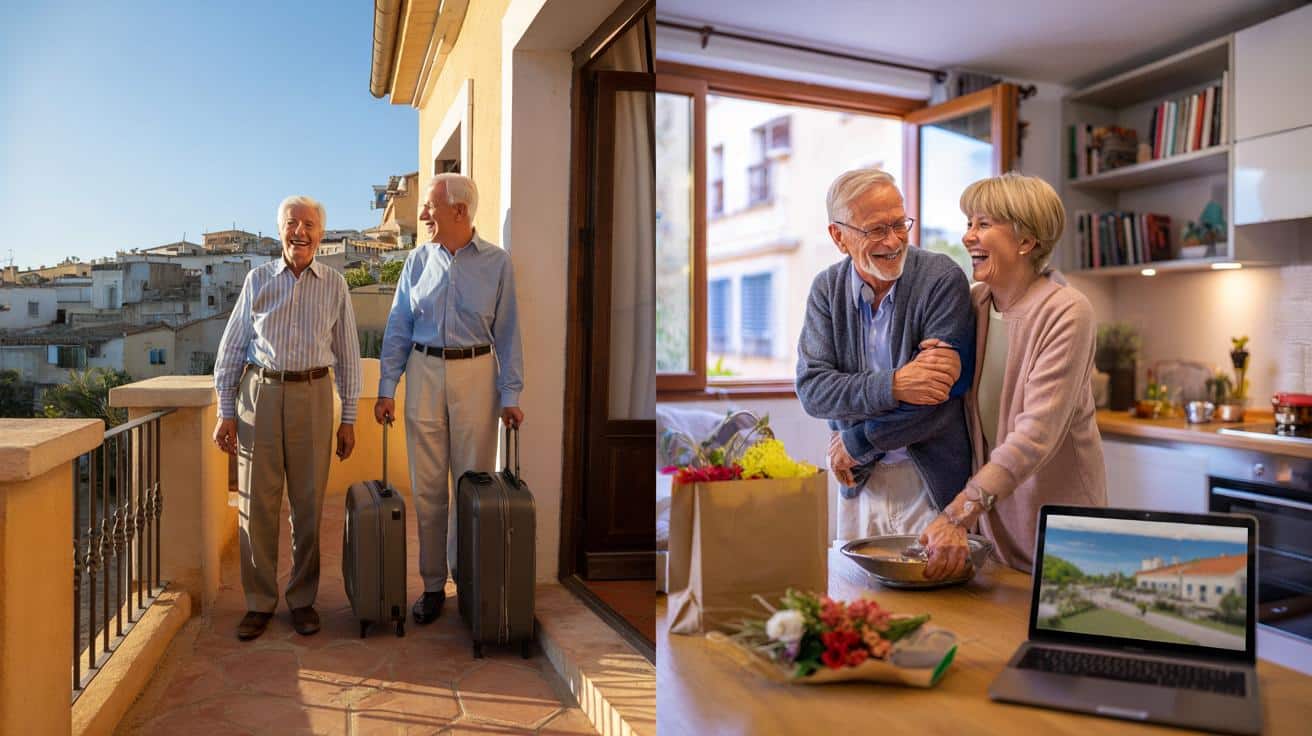
Retirement no longer means slowing down.
A growing number of over‑60s are quietly rewriting how they travel, and where they stay.
Across Europe and the US, retirees are turning to house swapping to stretch their pensions, travel for longer and meet new people, all while sidestepping crowded resorts and eye‑watering hotel bills.
From old‑school bartering to a new kind of holiday
Swapping homes is, at its core, a 21st‑century version of bartering. Two households agree to exchange their homes for a set period. No rent changes hands, there is no landlord, and no one runs it as a short‑term rental business.
House swapping turns an existing home into a travel resource, without adding new pressure to local housing markets.
Platforms such as HomeExchange and similar services act as matchmakers, but the logic stays the same: you stay in my place, I stay in yours. The focus sits on trust, mutual benefit and using what already exists rather than building new accommodation.
For many older travellers, this model lands at exactly the right time in life. After decades of work, children and fixed schedules, they suddenly have free weeks and months. What they often do not have is unlimited cash.
“I joined with fear – and then did 80 swaps”
Patricia, a retired Spaniard in her late 60s, had always loved travelling but kept a very close eye on the budget. She calculated that accommodation alone ate up around 30% of each trip. Her husband talked for years about trying a house swap. She hesitated.
Letting strangers sleep in her everyday home felt like a step too far. The idea of someone opening her wardrobes or cooking in her kitchen triggered a very human sense of vulnerability.
That changed when retirement approached. The couple agreed to try one exchange, treating it almost as an experiment. According to Patricia, she registered “with fear” — and then watched that anxiety melt away after the first stay. The experience went smoothly, the communication felt warm, and she came home to find her flat as she had left it.
Today, she has racked up more than 80 swaps, from coastal breaks to long weekends in European capitals. House swapping has turned four or five getaways a year into something realistic on a pension budget. The extra trips are not just about ticking destinations off a list. They bring, as she puts it, “a strong emotional part”: meeting people she would never have crossed paths with in a standard hotel stay.
➡️ Forget baking soda: this housekeeper’s trick makes bad odors disappear for good
➡️ This supermarket butter under €4 is the healthiest choice, according to 60 Millions de consommateurs
➡️ One spoon is enough : Why more people are putting coffee grounds in the toilet
Why the over‑65s are embracing home exchange
The numbers suggest Patricia and her husband are part of a clear trend. HomeExchange alone counts more than 27,000 members aged over 65, around 11% of its global community. Older travellers, once seen as loyal customers of coach tours and gated resorts, now show growing appetite for something more flexible and personal.
Retirees are using house swaps to travel off‑season, slow down and live like locals rather than just visit them.
Surveys in Spain, one of the hotspots for the movement, show almost a quarter of domestic travellers in 2024 were over 55. This cohort often prefers:
- off‑peak travel dates, when flights and trains are cheaper
- longer stays instead of short, rushed weekends
- quiet neighbourhoods instead of tourist strips
- time to cook, shop locally and walk, rather than scheduled excursions
House swapping fits those preferences almost perfectly. You gain a kitchen, space to relax, and a daily rhythm that feels more like living somewhere than passing through.
Companionship, not just cheap nights
For some seniors, especially those living alone, the attraction goes beyond economics. Cristina, 72, prefers to swap just one room in her flat rather than the entire property. Guests stay with her under the same roof.
That choice has little to do with money. She highlights the company. Hosting travellers — especially from other countries — makes her feel less alone. Conversations at breakfast or over an evening glass of wine bring language practice, new recipes, different views of politics and family life.
Many older hosts point to this human contact as a quiet antidote to loneliness, which affects a large slice of the retired population. A swap stop can turn into an ongoing friendship, messages exchanged after the trip, or even repeat visits.
For single retirees, hosting house swappers can double as social contact, cultural exchange and informal language school.
Trust, rules and that first leap of faith
The biggest psychological barrier usually comes at the start. Letting people you have never met sleep in your bed or borrow your pans runs against instincts built up over decades.
Platforms try to soften that leap through identity verification, messaging systems and review profiles. Still, seasoned swappers describe a few personal rules that help them feel comfortable.
How many seniors vet their swaps
- They read previous reviews carefully and avoid profiles with negative feedback.
- They often give newcomers a chance if they have no reviews, but stay cautious.
- They set clear house rules in advance: smoking, pets, visitors, noise.
- They lock away highly personal or irreplaceable items for peace of mind.
- They insist on video calls before confirming longer or more complex exchanges.
Once those habits settle in, many report that age itself stops mattering. The more swaps they complete, the more they focus on fit rather than fear: is the home clean and well located? Does the traveller seem respectful in messages?
Regular house swappers often say that trust builds fast once they see their own home treated with care.
The digital hurdle – and how retirees handle it
For some seniors, the biggest practical obstacle is not the idea of swapping, but the digital layer around it. Signing up to a platform, filtering listings, dealing with calendars and messaging systems can feel confusing at first.
Yet this friction usually fades. Many older users learn the basics with help from children or grandchildren. Others follow tutorials offered by the platforms themselves. After a few exchanges, they message, upload photos and manage dates with the same ease as younger members.
Advocates argue that house swapping can even act as a gentle push towards digital confidence. Managing profiles, scanning passports, or comparing destinations online gives concrete reasons to stay engaged with technology in retirement, rather than avoiding it.
Does house swapping hurt cities, or help them?
Debates around tourism increasingly circle around gentrification and housing pressures. Short‑term rentals can reduce the stock of housing available for locals and push up rents in popular districts. House swapping operates on a different logic.
| Aspect | Typical short‑term rental | House swap |
|---|---|---|
| Money changing hands | Yes, nightly rate paid | No, nights are exchanged |
| Dedicated tourist flats | Often yes | No, lived‑in homes |
| Impact on housing supply | Can reduce local housing stock | Uses existing primary residences |
| Spending pattern | More on accommodation | More on local shops, culture and food |
Because there is no rent, and the homes involved are usually main residences, advocates say the model does not push investors to buy properties purely as tourist assets. At the same time, money saved on hotels tends to go into local bakeries, independent cafés, small museums and public transport.
For less central neighbourhoods, that can bring a gentle trickle of visitors who are more likely to stay for a week, shop nearby and settle into a slower rhythm, instead of surging in on a quick weekend break.
How movies, inflation and covid quietly boosted swapping
The concept may sound niche, but it has hovered in mainstream culture for almost two decades. The 2006 romantic comedy “The Holiday”, where Cameron Diaz and Kate Winslet’s characters trade homes between Los Angeles and an English village, gave millions of viewers their first fictional glimpse of the idea.
Reality took longer to catch up. The real acceleration came after 2020. Lockdowns, travel bans, then inflation and soaring hotel prices pushed many households to rethink holidays. More travellers started looking for cheaper, more flexible ways to sleep away from home without sacrificing comfort.
Pandemic‑era budgets, a hunger for “normal life” abroad and a focus on sustainability pushed house swapping from niche hobby to mainstream option.
Older travellers, in particular, began to favour low‑key immersion over crowded sightseeing. Instead of dashing through five cities in ten days, they used swaps to spend two weeks in one small town, cook with local produce and chat with neighbours in the lift or at the market.
Practical risks and how seniors reduce them
Of course, house swapping is not friction‑free. Seniors especially often worry about three basic risks: property damage, last‑minute cancellations and health issues while abroad.
To manage those, experienced swappers recommend a few concrete steps:
- Photograph your home and valuables before each swap to keep a record.
- Check what insurance your platform provides, and where your own policy starts.
- Keep one back‑up accommodation option in mind if an exchange falls through.
- Share your travel and medical details with a relative, including your host’s contact.
- Agree clearly on bills, keys, cleaning expectations and arrival times in writing.
Many platforms offer guarantee schemes for damage and cancellation, which gives older users a further layer of reassurance when they consider their first try.
House swapping as a new face of retirement
For a generation that grew up with guidebooks and travel agents, the idea of crafting DIY trips based on shared homes might have sounded radical. Yet for retirees like Cristina, the practice has become part of daily life. She describes her later years as “a wonderful retirement, travelling more and on a tighter budget”.
Behind that simple sentence sits a deeper shift: travel no longer belongs only to the wealthy or to those willing to accept standard package holidays. A careful swap, carried out with clear rules and enough trust, can turn a modest pension into a passport to multiple cities each year.
For readers considering it, a low‑risk test might start with a weekend swap in your own country, or hosting just a room while you stay at home. That trial run can show you how it feels to share your space, how the platforms work and which boundaries you want to set. From there, longer exchanges — a month by the sea, three weeks in a smaller European city, or a quiet village near a national park — become realistic options rather than far‑off dreams.