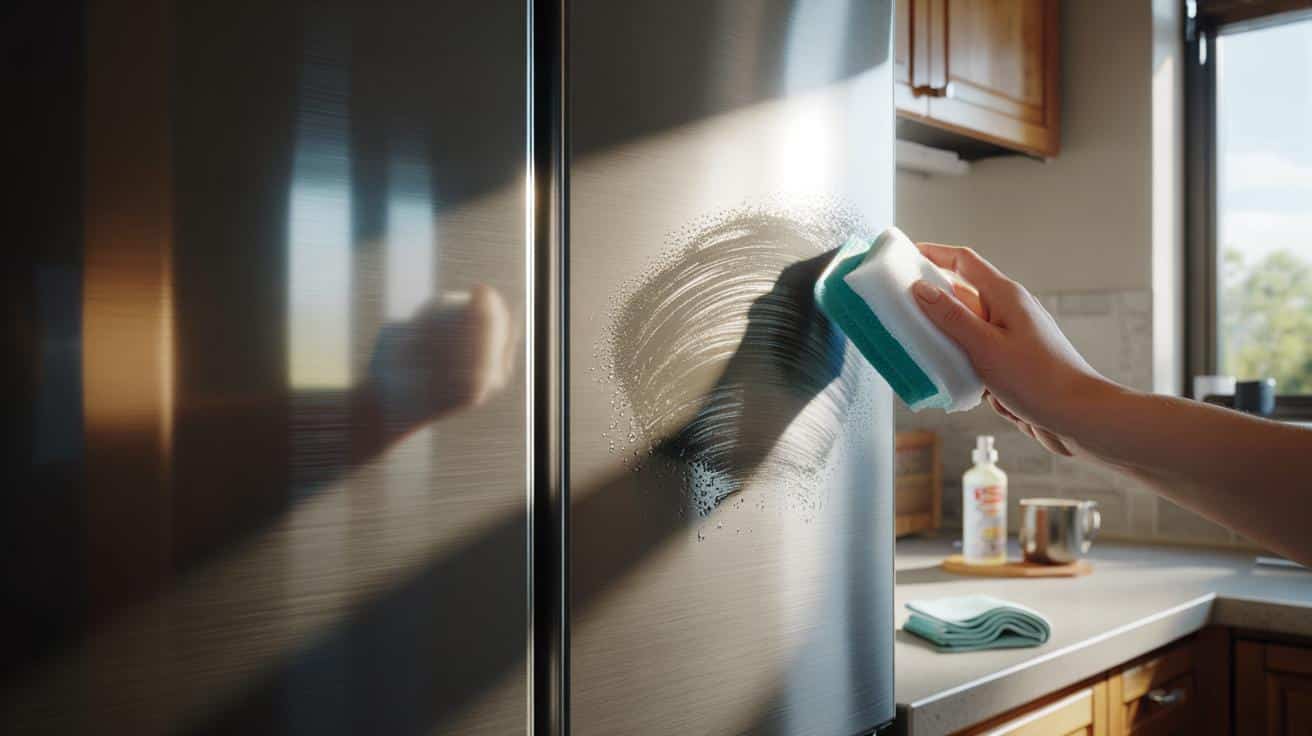
You’re standing in your kitchen, coffee in one hand, sponge in the other, staring at those greasy fingerprints smeared across your stainless steel fridge. The light hits just wrong, and suddenly every smudge seems ten times worse. You remember a friend swearing by magic erasers for “anything”, so you pull one out of the cleaning caddy with a tiny thrill of confidence. A few quick swipes, a bit of elbow grease, and… the prints are gone. Fantastic. You rinse, step back, and feel that small domestic pride bubbling up.
Then the sun shifts.
And your stomach drops.
Why magic erasers and stainless steel don’t mix
On the box, a magic eraser sounds almost miraculous. No harsh chemicals, just a little white sponge that “magically” lifts dirt and grime. The name alone makes you think it’s soft and gentle, something close to a regular sponge with superpowers. On glossy TV ads, nobody talks about what happens when that same sponge meets the brushed finish of your expensive fridge or oven. You just see the “before/after” shot and think, easy win.
The reality is very different. A magic eraser is basically ultra-fine sandpaper made out of melamine foam. It’s dense, it’s abrasive, and it works by literally scraping off a microscopic layer of whatever it touches. On ceramic walls or plastic sneakers, you barely notice that. On stainless steel, you see everything. That calm, satin finish your appliances had when they were brand-new? One enthusiastic cleaning session with a magic eraser can rewrite it forever.
Once you understand what stainless steel actually is, things click into place. That soft, brushed look comes from directional polishing during manufacturing, creating tiny, uniform lines that catch the light in a specific way. That finish is a surface, not a pattern printed underneath a protective coat. So when you rub a magic eraser over it, you’re not just “deep cleaning”, you’re sanding those lines unevenly. The result is cloudy patches, shiny bald spots, and random swirl marks that no amount of buffing can fully hide.
What really happens when you scrub: a closer look
Imagine a Saturday morning when you finally decide to deep clean the kitchen. You’ve got music on, a trash bag tied to the drawer handle, and a line of cleaning products across the counter. Your stainless steel dishwasher has that stubborn grey haze around the handle from constant touching. You run your hand over it and feel a bit of roughness from dried splashes. The magic eraser is right there. You wet it, squeeze it, and press.
At first, it feels great. The sponge glides, the marks fade. You press harder, moving a bit faster now, chasing each spot like a game. Ten minutes later, you step back and the main stain is gone. But something feels off. The metal in that area suddenly looks flatter, less “brushed”. You notice that where you scrubbed is smoother, almost shiny, and the rest of the panel still has that soft texture. You move your head from side to side, and there it is: a clear, dull patch that looks like a ghostly rectangle around the handle.
That patch isn’t dirt. It’s damage. The micro-abrasive foam has leveled the tops of those factory-made brush lines, creating a slightly polished, inconsistent surface. The light no longer bounces in one direction, it scatters. This is why some people say their fridge looks “blotchy” or “rainbowy” after cleaning with magic erasers. The structure of the finish has changed. You haven’t just cleaned the metal, you’ve reshaped it. And once the stainless is scratched in a random pattern, no cleaner can recreate the original, uniform factory brushing.
How to clean stainless steel safely—and what to avoid
For everyday smudges on stainless steel, the safest route is boringly simple. Start with a soft microfiber cloth, warm water, and a drop of mild dish soap. Wipe in the direction of the grain, not in circles, and don’t press like you’re scrubbing burnt pans. Rinse the cloth, wipe again, then dry with a second clean microfiber to avoid water spots. It’s calm, it’s slow, it’s not flashy. But your fridge will thank you in five years.
For shine and those classic fingerprint zones, a dedicated stainless steel cleaner or a tiny bit of mineral oil can do wonders. Spray lightly on the cloth (not directly on the appliance) and again, follow the grain. One pass to apply, one pass to buff. Let’s be honest: nobody really does this every single day. Most of us only remember when guests are coming or when the smears drive us mad. That’s exactly why, on those rushed cleaning days, we grab harsh products or “miracle” erasers and do the most damage in the shortest time.
➡️ A mother sets off to find her son missing for five years and what she discovers tears families apart
➡️ One spoon is enough : Why more people are putting coffee grounds in the toilet
➡️ This flight crew secret keeps shoes spotless on long trips
➡️ Controversy as bird experts claim this winter fruit traps robins in the same garden for years
➡️ Road safety signals Here’s what a yellow rag on a motorbike’s handlebar really means
➡️ The body signal that often appears weeks before burnout hits
The big don’ts are pretty straightforward. Avoid steel wool, scouring powders, magic erasers, stiff brushes, and any “multi-surface” sponges that feel gritty to the touch. A simple rule: if it feels rough on your skin, it’s rough on your stainless.
*“Stainless steel is durable, but its finish is fragile,”* says a professional appliance technician. “Most of my calls about ‘broken’ doors are just scratched panels that can’t be undone.”
- Use soft microfiber cloths only for wiping and buffing.
- Follow the grain every single time you touch the surface.
- Test new products on a hidden edge before going all in.
- Avoid scrub pads, magic erasers, and abrasive powders.
- Dry the surface after cleaning to prevent streaks and mineral marks.
Living with stainless steel without losing your mind
Stainless steel has become shorthand for a “modern” kitchen, yet no one warns you that it behaves a bit like a sensitive diva. It looks incredible on day one, reacts to every fingerprint on day two, and spends the rest of its life negotiating with your cleaning habits. Once you’ve seen what a magic eraser can do to that brushed finish, you start looking differently at those little white sponges under the sink. Powerful on walls, tragic on fridges. Two truths can exist at the same time.
We’ve all been there, that moment when you’re tempted to grab the fastest, strongest thing just to feel on top of the mess. The quiet reality of stainless is that the gentlest methods are the ones that keep it beautiful. A soft cloth, a bit of soap, a light oil once in a while: it’s not glamorous, but it’s sustainable. The next time someone proudly tells you they “fixed” their steel with a magic eraser, you’ll know what to look for in the reflection. And you might be the one who saves a very expensive fridge door from a one-way trip to cloudy, scratched regret.
| Key point | Detail | Value for the reader |
|---|---|---|
| Magic erasers are abrasive | They act like very fine sandpaper on metal surfaces | Helps you avoid irreversible scratches on stainless steel |
| Stainless has a directional grain | The brushed finish is created by uniform polishing lines | Explains why scrubbing across the grain leaves visible marks |
| Gentle methods work best | Microfiber, mild soap, and dedicated cleaners protect the finish | Keeps appliances looking newer for longer without extra effort |
FAQ:
- Can I ever use a magic eraser on stainless steel?
Technically you can, but you’ll almost certainly create dull or shiny patches, especially on brushed finishes. It’s strongly discouraged if you care about the original look.- I already used a magic eraser and see cloudy spots. Can this be fixed?
Minor damage can sometimes be reduced with professional stainless polish, but the factory finish is rarely restored perfectly. Deep or wide patches are usually permanent.- What’s the safest quick cleaner for daily fingerprints?
A damp microfiber cloth followed by a dry one is enough most days. For stubborn marks, a drop of dish soap on the cloth, wiped then rinsed and dried, works well.- Are all stainless steel finishes equally sensitive?
No. Brushed and satin finishes show damage more than textured or matte “fingerprint-resistant” models. But abrasive tools are still risky on all of them.- Is vinegar safe for stainless steel appliances?
Diluted vinegar can remove light mineral spots, but use it sparingly, on a cloth, not soaking the metal, and always rinse and dry thoroughly afterward.