The kitchen clock blinks 11:47 p.
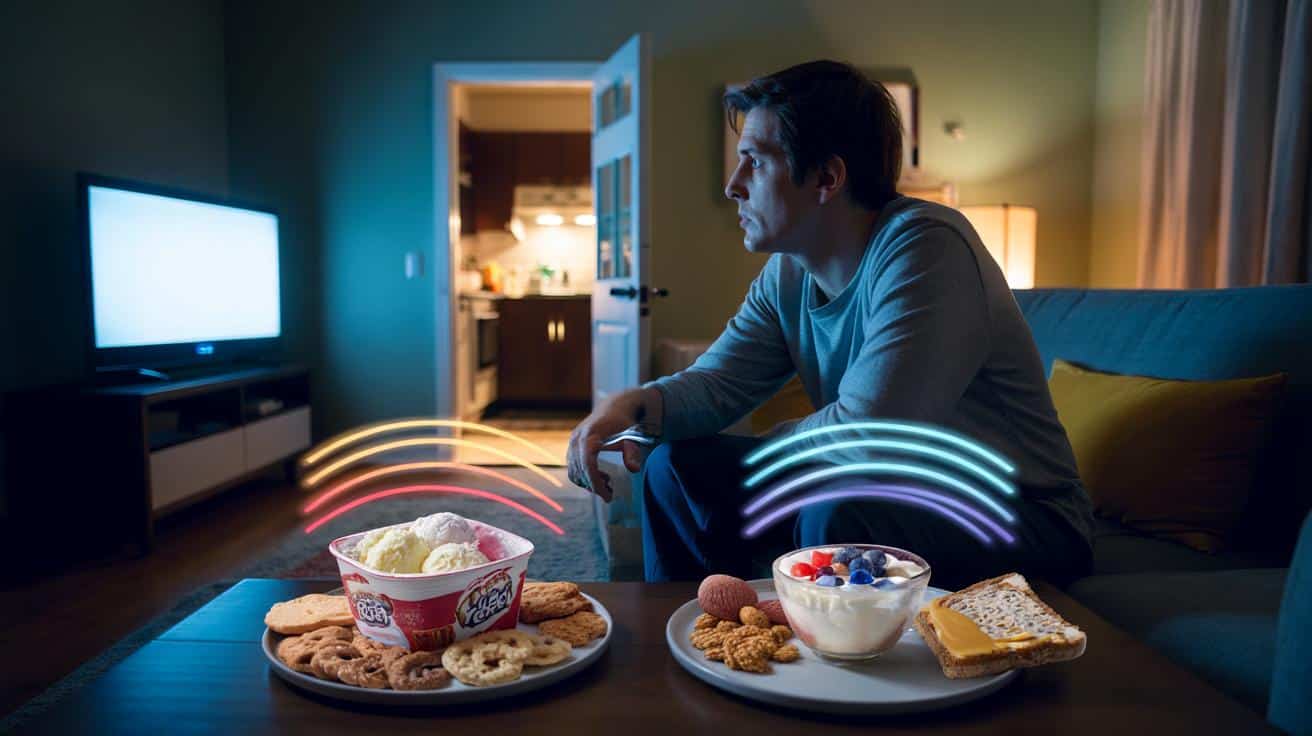
m. The house is quiet, your Netflix episode just ended, and there it is: that gentle, annoying pull toward the fridge. You’re not starving, just… restless. You tell yourself a small bowl of cereal, a couple of cookies, maybe a slice of toast with jam won’t hurt. It’s late, but you had a long day. You deserve something.
Ten minutes later, you’re back on the sofa, spoon in hand, scrolling on your phone. You feel oddly satisfied, a bit heavy, but calm. Sleep will come soon, you think. What you don’t see is the invisible wave rising inside: your blood sugar climbing, then wobbling, then crashing while you sleep.
Your body is doing math in the dark. And the equation is not always in your favor.
What late-night snacking really does to your blood sugar
We imagine our bodies shutting down slowly at night, like a computer entering sleep mode. In reality, your metabolism is still busy, just less flexible. Late at night, your muscles are resting, your liver is on a different schedule, and your cells are slightly less responsive to insulin. So when that late snack arrives, the timing is off.
Instead of handling sugar smoothly, your blood glucose tends to spike higher and hang around longer. You may not feel it as a “spike”, but you might notice being wired in bed, waking up at 3 a.m., or dragging yourself out of sleep like you’ve been hit by a truck. That’s often your nighttime blood sugar story.
Researchers see this on continuous glucose monitors all the time. Two identical meals, one at 7 p.m., one at 11 p.m., and the late one almost always causes a sharper swing. Same food, same person, totally different curve.
In one small study, people who ate a big snack close to midnight had higher blood sugar all night and more erratic readings in the early morning. They didn’t necessarily feel sick. They just woke up more tired, hungrier, and with stronger cravings for something sweet at breakfast. That’s how the cycle quietly hooks you.
On a more personal level, think of that friend who says, “If I eat ice cream at night, I can’t sleep.” That’s not just a personality quirk. Late sugar can push your blood glucose up, trigger a rush of insulin, then leave you dipping low during the night. Your brain hates that roller coaster. It sends out stress signals, nudges you awake, and you find yourself staring at the ceiling for no obvious reason.
The logic behind all this is brutally simple. Your internal clock — the circadian rhythm — programs your organs to expect food during the day, not at midnight. As the evening goes on, insulin sensitivity usually drops. That means your body needs more insulin to handle the same amount of carbs, and the clean “rise and fall” of glucose turns into more of a jagged hill.
When blood sugar stays high at night, it can interfere with deep sleep and with the release of growth hormone, which your body uses to repair tissues. Over time, regular late-night spikes are linked with higher fasting glucose, more belly fat, and a higher risk of insulin resistance. It doesn’t happen in a week, of course. It creeps in quietly, snack by snack.
➡️ The hidden link between dehydration and sudden headaches
➡️ Road safety signals Here’s what a yellow rag on a motorbike’s handlebar really means
➡️ What your walking speed reveals about your long-term health
➡️ We Asked 5 Chefs How to Make Perfect Scrambled Eggs – They All Gave the Same Answer
None of this means you’re doomed if you eat after 9 p.m. It means timing and type of food become part of a bigger story your blood sugar is trying to tell.
How to snack at night without wrecking your blood sugar
If you’re going to snack late, structure the snack like a small, balanced mini-meal. That means pairing carbohydrates with protein and a little fat, so your blood sugar rises more gently and stays steadier. Think Greek yogurt with a few berries, a slice of wholegrain toast with peanut butter, or a small piece of cheese with an apple.
Portion size matters more than we’d like to admit. The goal isn’t to “fill up”, it’s to take the edge off. Aim for something you could hold in one hand, not a second dinner. Eat it sitting down, at a table if you can, not mindlessly over the sink or in front of the fridge with the door open and the light buzzing.
And give your body at least an hour between your last bite and turning off the light. That short gap already helps your blood sugar curve look calmer.
Most people don’t get into trouble because of one late snack. The real trap is the automatic, every-night habit: the chips bowl that appears with your series, the ice cream tub that signals “day is done”. On a tired brain, that pattern is almost irresistible. You’re not weak; you’re wired this way.
One strategy that helps is changing the script, not just the food. If you usually snack the moment you hit the sofa, insert a tiny ritual first: brush your teeth, make a herbal tea, stretch for three minutes. Anything that forces a pause. Often, your body just wanted comfort, not calories.
Soyons honnêtes : personne ne fait vraiment ça tous les jours. You’ll have nights where you go straight from couch to cookie. That’s life. The key is noticing when the “sometimes” turns into “always”, especially if your sleep is messy, your mornings are heavy, or your doctor starts mentioning fasting glucose numbers that inch up year after year.
“Late-night snacking doesn’t have to be forbidden,” says one nutritionist I spoke with. “But if your blood sugar is on a knife edge, the clock matters just as much as the plate.”
There are a few simple filters you can run every night before you raid the kitchen. *Am I actually hungry, or just bored, stressed, or avoiding going to bed?* If it’s real hunger, a small, protein-anchored snack can help your blood sugar stay more stable than going to bed starving and waking up at 4 a.m. ready to eat the world.
- Choose protein + fiber over pure sugar (nuts + fruit beat cookies).
- Keep “hyper-palatable” snacks (chips, candy, ice cream) out of arm’s reach.
- Use a small bowl or plate, never the whole bag or tub.
- Try a “kitchen closed” time on work nights, even if it’s flexible.
- Watch how your sleep and energy react for a week; adjust from there.
Rethinking those quiet, late moments with food
We rarely talk about blood sugar when we talk about late-night eating. We talk about guilt, or comfort, or “being good” next week. Yet inside your body, those moments are data points. Over months and years, they shape how your cells respond to insulin, how easily you gain weight, how calm your brain feels at 2 a.m.
On a human level, there’s also something tender about that late-night snack. It often shows up when the day has been hard, when the house is finally quiet, when nobody is watching. On a tous déjà vécu ce moment où le frigo devient plus confident que machine. You’re not just eating; you’re unwinding, numbing, rewarding, stalling.
Blood sugar offers a different lens. Instead of “Am I being good?”, the question becomes “What will this do to my night?” That small shift can be surprisingly powerful. You start seeing patterns: the nights with a heavy dessert where sleep feels choppy; the nights with a light, balanced snack where you wake up clearer. You notice that your body votes, silently, every single evening.
You don’t need a continuous glucose monitor to make changes. You can track simpler signals: how long it takes to fall asleep, how often you wake, how you feel in the first 30 minutes after getting out of bed. If late-night snacking is your norm and your mornings are a fog, there’s a good chance your blood sugar is writing part of that story.
Some people choose to set a loose “no food after 10 p.m.” boundary. Others focus on swapping their usual sweets for something less dramatic on glucose, like a small bowl of plain yogurt, a boiled egg with a cracker, or a handful of nuts and a mandarin. None of this has to be perfect. Tiny, consistent tweaks beat rigid rules that snap the first stressful week.
Maybe the real question isn’t “Should I snack at night?” but “What kind of tomorrow am I stealing from myself when I do?” It’s not always a tragedy; sometimes the joy of that shared pizza at midnight is worth a groggy morning. The point is to make it a choice, not a reflex written by fatigue and sugar.
| Point clé | Détail | Intérêt pour le lecteur |
|---|---|---|
| Timing shapes glucose | Same snack causes higher blood sugar late at night than earlier in the evening. | Helps you pick smarter hours for eating, especially on busy days. |
| Snack structure matters | Protein + fiber slow down sugar absorption and flatten spikes. | Gives you practical snack ideas that won’t wreck your sleep. |
| Patterns beat perfection | Regular late-night spikes can nudge insulin resistance over time. | Invites small, sustainable changes instead of all-or-nothing dieting. |
FAQ :
- Does one late-night snack really affect my blood sugar that much?For most healthy people, a single late snack won’t cause lasting damage, but you can still get a higher spike and more restless sleep that night, especially if the snack is sugary or large.
- What are the worst late-night snacks for blood sugar?Foods high in refined carbs and sugar with almost no protein or fiber — like candy, cookies, sweet cereals, white bread with jam, or ice cream — tend to hit blood sugar the hardest.
- Is it better to go to bed hungry than to eat late?If you’re truly hungry, a small, balanced snack is usually better than going to bed starving, which can trigger nighttime awakenings and morning overeating.
- How long before sleep should I stop eating?Many sleep and metabolism experts suggest leaving roughly 2–3 hours between your last substantial food and bedtime, though even a 60–90 minute gap can already help.
- Can changing my evening snacks really improve my fasting glucose?For people with prediabetes or higher fasting glucose, reducing or restructuring late-night snacks is often one of the simplest moves that leads to better morning readings over a few weeks.